Fixed Wireless Internet
Skyway West provides Fixed Wireless broadband services in speeds from 1.5 Mbps to 100 Mbps. Our serving area covers the BC Lower Mainland and cities and industrial parks from Montreal to Victoria.
Broadband for hard-to-reach locations:
- symmetrical high performance service from 3 Mbps to 100 Mbps
- reach locations where wired services such as Fibre, ADSL or Cable are unavailable
- best choice for network redundancy because it bypasses “last mile” wiring
- faster installation than fibre and bandwidth can be quickly upgraded
- 5 permanent public IP addresses and a four port router
- experienced, responsive technical support trained for business networks
- Service Level Agreement
Speeds: 1.5 mbps to 100
Starting at $299/month
WIRELESS INTERNET services include:
- 5 Usable Static IPs transferable between services and locations
- Email Accounts 10 Free, including Spam and Virus protection
- Domain Name Hosting up to 3 domain names
- Control Panel secure web access to monitor network health and manage Domain Names and email accounts. Includes service alerts, usage reports and traffic analysis
- Industry-best Skyway West Support
FAQs All You Need to Know About WIRELESS INTERNET
Fixed Wireless is a reliable cost-effective alternative to Fibre and T1 services in hard-to-reach locations, or as a backup for other Broadband services. It offers greater upstream speed than ADSL or Cable. Wireless can be provisioned at any available speed and can be installed much quicker than ADSL, T1 or Fibre.
Wireless services are symmetrical, meaning the upload and download speeds are the same. The speed of an individual service is programmed into your equipment and can be remotely changed to your requirements.
1. Customer Premise Antenna
Our wireless network connects to an outdoor antenna or dish placed in a mount typically located on the roof of your building.
We use four main types of mounts:
a. Air-conditioning Unit Mounts
b. Pole Wall Mounts
c. Roof Mounts (Non-Penetrating Roof Mounts and Non-Penetrating Tripod Mounts)
d. Short Guyed Tower Mounts
An experienced technician ensures the antenna installation and wiring are done in full co-operation with the building owner and according to their specifications.
2. Customer Premise Subscriber Unit (SU)
The antenna is connected by coax cable (similar to CATV) or ethernet cable to a wireless radio or subscriber unit (SU) located in the antenna housing, or in the building’s service or elevator room. The SU requires a power outlet and is usually connected to a network switch. The switch connects by CAT5 cabling through the building’s riser closet to an ethernet jack in the customer’s premise.
The SU brand and model depend on the distance your location is from our nearest Wireless Access Point. Our SU’s are chosen for their quality construction, efficient throughput and the security measures they take to ensure your wireless traffic is secure.
3. Wireless Network Access Point (AP)
The antenna connect the SU’s to Access Points (AP) strategically positioned on building roof tops and towers located across the Wireless serving area.
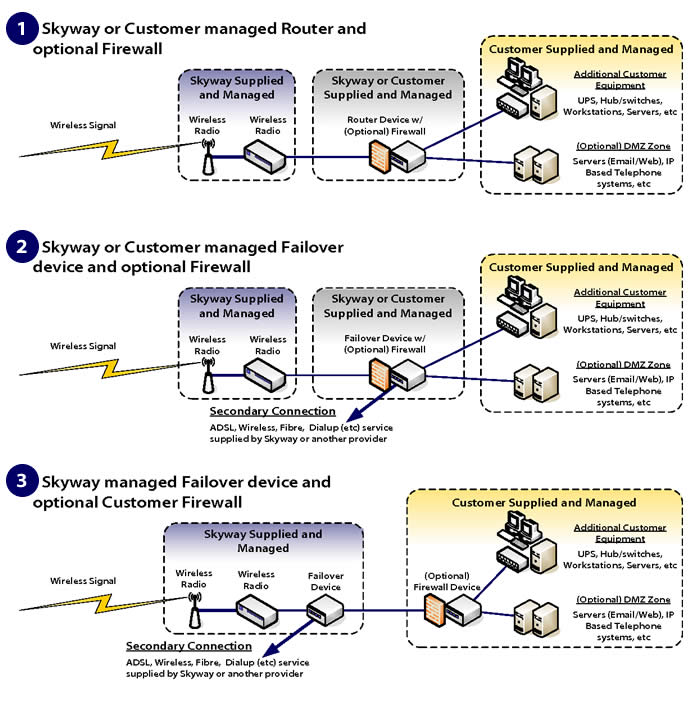
Click on the “Setup Options” tab above for a Customer Premises Setup Options diagram.
1. Frequencies
We typically use licensed frequencies (e.g., 24 GHz Band, 38 GHz Band) within our network and assign our customers license-exempt frequencies (e.g., 4.8 GHz, 5.8 GHz). The primary difference is that licensed radio users have a regulatory body that will assist them in overcoming any interference issues that may arise, while license-exempt users must resolve interference issues without governmental assistance.
2. Security
All Internet connections using public IP addresses are insecure. Wireless is no different. A VPN is the only way to secure an Internet connection.
Radios are normally located on building roof tops and only accessible when accompanied by the building manager. There is a small risk that a signal may spill over to a neighbour or that somebody would intentionally intercept a signal. We mitigate these risks by programming as narrow a line-of-sight as possible and using sophisticated features and proprietary transmission coding between our network and customer locations. Our network is secure enoough to handle credit card and Interac (including PIN#) transactions.
3. Weather
Skyway wireless services are engineered to avoid the influence of weather. The most important factor is a clear line-of-sight to our network. We avoid rain problems by using sensitive equipment and limiting the distance to a customer site. Snow is not a problem because our radios operate at 37 degrees Celsius melting away ice and snow build up.
4. Other Obstacles
Wireless can also be affected by other environmental factors, including roof maintenance, new neighbourhood buildings and other line-of-sight impediments, and even birds nesting and roosting on antennas.
Our wireless services are available as full or half duplex. A full duplex connection simultaneously sends and receives data packets. It is typically used to connect switches together or to connect fast access devices such as workgroup servers. It is also best for services like VoIP where both parties may speak at the same time. The combined throughput is the listed speed.
A half duplex connections sends packets and waits for a response before sending more packets. Is is a request/response network connection and when one device is sending, all the other devices are receiving. If more than one device is sending, collusions occur and packets must be resent. Half-duplex is the most common transmission method and is adequate for normal workstation and PC connections. Most client server traffic is half duplex as is web browsing, email and ftp.
Skyway fixed wireless is available in British Columbia (BC), Alberta (AB), Manitoba (MB), Ontario (ON) and Quebec (QC). Contact us to confirm your location, we are continually expanding.
Get a Wireless Quote
The Skyway West Wireless Service Level Agreement
Skyway guarantees all wireless customers 100% uninterrupted transit to the Internet. If transit to the Internet becomes unavailable, Skyway will refund the customer an amount equal to one day of the customer’s pro-rated recurring monthly charges during the month the interruption took place.
If transit to the Internet is unavailable for a cumulative period exceeding one hour, the customer will receive an additional refund of one day of the pro-rated recurring monthly charges for each additional hour, or portion thereof, of transit unavailability. All refund calculations will be based on unavailability in one-hour increments.
This SLA does not cover outages caused by equipment and/or events not under the direct control of Skyway or caused by individuals not directly employed by Skyway. It excludes short periods of temporary service degradation, such as slow data transmissions. It does not cover outages due to scheduled or emergency network and/or facility maintenance, which will be broadcast to all customers in advance.
Any and all refunds to a customer will not exceed 35% of the customer’s recurring monthly charges for the month in which the refund is paid.